
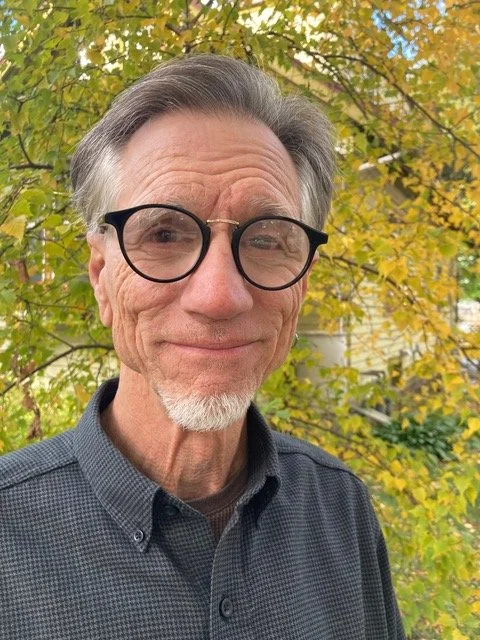
Guy Thorvaldsen
CONTACT:
Email
BIO:
Guy Thorvaldsen is a first generation, Norwegian-American carpenter who grew up extremely curious about how the world is put together. His carpentry has appeared in in a myriad of different places. His second act was teaching community college English for 20 years, teaching and studying how human beings learn, understand themselves, communicate with each other, bridge cultural gaps, and build community. The third act is tinkering and thinking in his workshop and at his desk, building poems, furniture, community and stories. His family, friends, and nature are the foundation for all else.
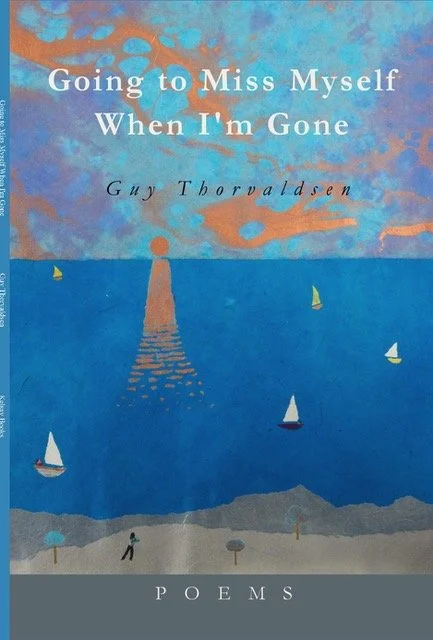
Guy’s poetry has appeared in, among others, Alligator Juniper, Forge, Gulfstream, Magma 69, Zone 3, Poet Lore, Sports Literate, Isthmus, and Verse Wisconsin. His poem “Sweeping” was nominated for a Pushcart Prize, and his first full-length book of poetry, Going to Miss Myself When I’m Gone came out in October 2017 through Aldrich Press.
PUBLICATIONS:
Going to Miss Myself When I’m Gone (2017, Aldrich Press).
Poetry
This Boy
for Bjorn
It was easier to conclude that he’s the first
gay member of the clan, more comforting
to imagine it simply took this long
for the family genetic slot machine
to turn up three ruby red slippers
and leave it at that, allowing us to be
smugly content in our regular sexual brand,
to marvel at this new breed,
as if he was invented, not conceived.
Much harder to allow ourselves to recall
the other gay siblings who surely came before:
brown-eyed, wooden-shoed Norwegian girls and boys,
born with lovely names that echoed among
clefted valleys and fjords. Children, for whom
the world was perfect until it wasn’t.
But now, we are asked to welcome this one
whose eyes shine like icefields in sun
whose deeply veined hands trace
an undeniable map of our past
reminding us that blood never produces
a true stranger. So we reach back
with a prayer, a tender filament of our heart
sent to the spinster aunt in search of a sister,
the soulful Uncle a brother,
or the barely married staring out the window
to where the road disappears, waiting
for this one, this boy to make his way home.
Tracks
My student,
profoundly deaf,
struggles with her grammar.
And spelling. And tenses.
She’s not even close.
I ask the interpreter
to use her secret finger language
to ask my student
to break down
words into syllables,
so my student
‘can’ ‘sound’ ‘out’ ‘each’ ‘one’ ‘in’ ‘her’ ‘head.’
But the interpreter
informs me that she cannot
make her student hear sounds,
anymore than I can erase the blindness
of my ‘au’ ‘ral’ ‘priv’ ‘i’ ‘lege’.
So I try again,
notice that my student’s essay
is not constructed of sounds at all,
but rather silence,
a snow-covered field
covered with the black footprints
of 26 different species
who are promiscuously
disloyal to their tribes,
their tracks an eccentric collection
of hybrid animal groups
that can change their meaning
depending on whom they are hanging out with.
Or so I imagine.
Time to ask my student, who is now busy
flashing sophisticated gang signs with her interpreter,
a three-dimensional language
that leaves clueless me in the dust,
an alphabet that disappears as quickly as it is formed,
leaves no tracks at all.
Published in Magma 69, a poetry journal in London, England